MCQ Exam Test
  • Current affairs
  • Educational Development
  • Competitive exams
  • About Us
  • Contact Us
  • © 2026 mcqexamtest. All rights reserved.

    • About Us
    • Contact Us
    • Privacy Policy
    • Terms & Conditions
    • FAQ
    1. Home
    2. →
    3. Astrobiology
    📚

    Astrobiology

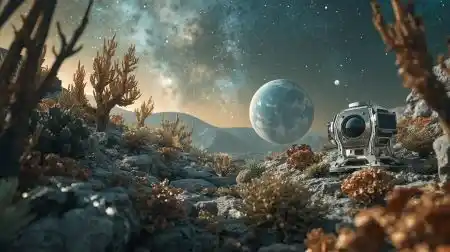
    Astrobiology represents the thrilling intersection of astronomy, biology, and chemistry, dedicated to the search for life beyond Earth. This category explores the conditions necessary for habitation, the study of extremophiles on Earth, and the potential for biosignatures on other planets and moons. Learners will delve into the science of exoplanets, the origins of life in the universe, and the future of space exploration. It sparks the imagination regarding humanity's place in the cosmos and discusses the scientific and philosophical implications of discovering extraterrestrial organisms, from microbes to intelligent civilizations.

    Astrobiology

    Astrobiology

    Start Quiz
    0/1

    Astrobiology is an interdisciplinary scientific field that investigates the origin, evolution, distribution, and future of life in the universe — both on Earth and beyond. Also known as exobiology or bioastronomy, it combines knowledge and methodologies from astronomy, biology, chemistry, geology, atmospheric science, and planetary science to address some of the most profound and enduring questions in all of science — How did life begin on Earth? What are the conditions necessary for life to exist? Are there other planets capable of supporting life? Is there life elsewhere in the universe? These questions, once confined to the realm of philosophy and science fiction, are now the subject of rigorous scientific investigation, driven by remarkable advances in telescope technology, space exploration, and our understanding of life in extreme environments on Earth.Astrobiology is grounded in the study of life in extreme environments on Earth, known as extremophiles — organisms that thrive under conditions of extreme heat, cold, acidity, pressure, radiation, or salinity that would be lethal to most known life forms. The discovery of hydrothermal vent ecosystems on the deep ocean floor, microbial communities beneath Antarctic ice sheets, and acidophilic organisms in highly acidic volcanic lakes has dramatically expanded our understanding of the environmental limits of life and has raised the possibility that similar organisms could exist in analogous environments on other planets and moons in our solar system. Mars, with its evidence of ancient liquid water and subsurface ice, and the icy moons of Jupiter and Saturn — particularly Europa, Ganymede, Enceladus, and Titan — are considered the most promising candidates for extraterrestrial life within our solar system, and are the targets of numerous ongoing and planned space exploration missions by NASA and the European Space Agency.The search for life beyond our solar system has been energized by the discovery of thousands of exoplanets — planets orbiting stars other than our sun — by missions such as the Kepler Space Telescope and the Transiting Exoplanet Survey Satellite (TESS). The identification of exoplanets in the habitable zones of their host stars — regions where liquid water could potentially exist on the surface — has opened exciting new possibilities for finding Earth-like worlds that might harbor life. The James Webb Space Telescope, launched in 2021, is now capable of analyzing the atmospheric compositions of exoplanets, searching for biosignatures — chemical indicators of biological activity such as oxygen, methane, and water vapor. Astrobiology also examines the panspermia hypothesis, which proposes that life or its chemical precursors could be transferred between planets through meteorites and comets. As space exploration capabilities continue to advance and our knowledge of potentially habitable environments expands, astrobiology stands at the exciting frontier of human knowledge, holding the tantalizing prospect of answering one of humanity's oldest and most fundamental questions — are we alone in the universe?

    Explore More Categories

    Discover a wide range of quiz categories to test your knowledge and have fun!

    Accounting

    Accounting

    Test your knowledge of recording, analyzing, and managing financial transactions.

    Explore Category
    Science

    Science

    Includes Physics, Chemistry, Biology, and General Science for school and competitive exams.

    Explore Category
    General Knowledge

    General Knowledge

    General Knowledge is a broad understanding of diverse subjects, facts, and current events that enhances awareness and learning.

    Explore Category
    Agriculture

    Agriculture

    Test your knowledge of farming, crops, and livestock with this fun and educational Agriculture Quiz.

    Explore Category
    Law

    Law

    Covers legal principles, rights, justice, and the system that governs society.

    Explore Category