tughlaq-dynasty - Part 1
Self-paced MCQ practice with instant results after you submit.
Quiz collection
The Tughlaq Dynasty was the third major ruling dynasty of the Delhi Sultanate and ruled large parts of northern India from 1320 to 1414 CE. It was founded by Ghiyas-ud-din Tughlaq...
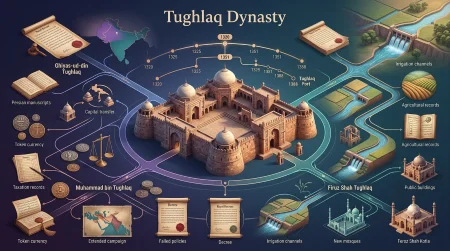
The Tughlaq Dynasty was the third major ruling dynasty of the Delhi Sultanate and ruled large parts of northern India from 1320 to 1414 CE. It was founded by Ghiyas-ud-din Tughlaq after the decline of the Khilji Dynasty. The Tughlaqs played an important role in the political, administrative, and architectural history of medieval India. Muhammad bin Tughlaq, who ruled from 1325 to 1351 CE, is remembered for several ambitious administrative and economic measures. These included the transfer of the capital from Delhi to Daulatabad, the introduction of token currency, and changes to taxation in the Doab region. Some of these policies faced practical difficulties and contributed to political and economic problems. Firoz Shah Tughlaq, who ruled from 1351 to 1388 CE, focused on public works, irrigation, agriculture, and administrative development. He constructed canals, gardens, towns, and monuments and supported the establishment of educational and charitable institutions. The dynasty also contributed to the development of Indo-Islamic architecture, with notable structures and cities associated with the Tughlaq period. After Firoz Shah Tughlaq's death, the dynasty experienced political instability and declining central authority. The invasion of Timur in 1398 CE further weakened the Delhi Sultanate. The Tughlaq Dynasty eventually came to an end in 1414 CE, when Khizr Khan established the Sayyid Dynasty.
Self-paced MCQ practice with instant results after you submit.
No quizzes match your search.
No approved reviews yet. Be the first to share your experience.
Each quiz is designed to comprehensively test your knowledge on the selected topic. Here's what you can expect:
You must answer all questions before submitting — no question can be left blank
All questions are multiple choice with 4 options (A, B, C, D) where only one answer is correct
Quizzes typically contain 10–25 questions depending on the category and difficulty
Each question carries equal marks for fair assessment of your knowledge
Review all your answers before final submission to catch any mistakes
Cannot change or select another option after selection
Take your time to read each question thoroughly. Since there's no time limit, make sure you understand what's being asked before selecting an answer.
If you're unsure, try eliminating options you know are incorrect. This increases your chances of selecting the right answer.
Your first instinct is often correct. While you should be careful, avoid changing answers unless you're certain you made a mistake.
Before hitting submit, review all your answers to ensure you haven't accidentally skipped any questions or made careless mistakes.
After viewing your results, take time to understand why you got certain questions wrong. This helps improve future performance.
Don't worry about getting everything right the first time. Taking quizzes multiple times helps reinforce your knowledge.
Explore other sub topics and keep practicing across the subject.