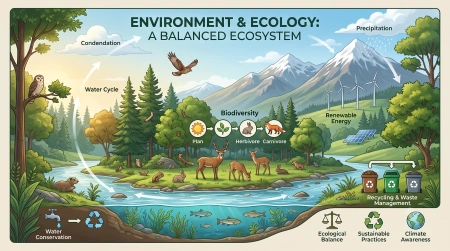
Environmental Studies is an interdisciplinary academic field that examines the complex relationships between human beings and the natural environment, integrating knowledge from natural sciences, social sciences, humanities, and technology to understand and address the pressing environmental challenges facing our planet today. It encompasses the study of ecosystems, biodiversity, natural resources, pollution, climate change, sustainable development, and environmental policy, providing learners with a holistic understanding of how human activities impact the Earth's ecological systems and what measures can be taken to protect and restore them.The field of environmental studies draws upon multiple disciplines including biology, chemistry, physics, geography, economics, sociology, and law to analyze environmental problems from diverse perspectives. It explores how industrialization, urbanization, deforestation, agricultural practices, and energy consumption contribute to environmental degradation, and how these changes in turn affect human health, food security, water availability, and social equity. Topics such as air and water pollution, solid waste management, soil erosion, loss of biodiversity, ozone depletion, and greenhouse gas emissions are central to the curriculum, providing students with both theoretical knowledge and practical problem-solving skills.Environmental studies play a vital role in cultivating environmental awareness, ecological literacy, and a sense of responsibility among individuals, communities, and policymakers. It promotes the concept of sustainable development — meeting the needs of the present without compromising the ability of future generations to meet their own needs. Environmental impact assessments, green technology, renewable energy adoption, conservation programs, and international environmental agreements such as the Paris Agreement are all areas addressed within this field. As the world grapples with accelerating climate change, habitat destruction, and resource depletion, environmental studies has emerged as one of the most critical and relevant fields of education, equipping future generations with the knowledge and values needed to build a more sustainable, equitable, and environmentally responsible world.