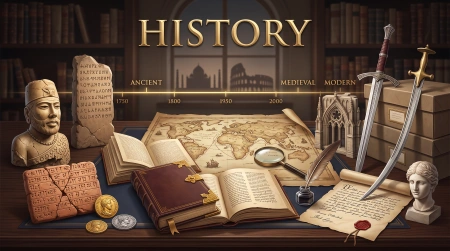
History is the analytical study of the events, movements, and figures that have forged the contemporary world. This category moves beyond rote memorization of dates to explore the causes and effects of wars, revolutions, and social transformations. It connects the dots between past economic shifts and current political climates, offering lessons on leadership, resilience, and human error. By engaging with the narratives of different cultures and eras, learners develop a historical consciousness that allows them to critically evaluate present-day issues through the lens of past experiences and heritage.

History of Europe is a vast, complex, and profoundly influential narrative spanning thousands of years, encompassing the rise and fall of civilizations, empires, monarchies, and republics that have collectively shaped the political, cultural, intellectual, and economic foundations of the modern world. Europe's history begins with prehistoric settlements and the ancient civilizations of Greece and Rome, progresses through the medieval feudal kingdoms and the Renaissance, and extends through the Age of Exploration, the Scientific Revolution, the Enlightenment, the Industrial Revolution, two devastating World Wars, and the formation of the European Union — each era leaving an indelible mark on the continent and the world at large. Ancient Greece, flourishing between the 8th and 4th centuries BCE, laid the intellectual and cultural foundations of Western civilization through its extraordinary contributions to philosophy, democracy, mathematics, science, literature, and art. Greek city-states such as Athens, Sparta, and Corinth developed distinct political systems and cultural traditions, while thinkers like Socrates, Plato, Aristotle, and Pythagoras transformed human understanding of the world. The conquests of Alexander the Great spread Greek culture across a vast territory from Egypt to Central Asia, creating the Hellenistic world. Rome subsequently inherited and expanded upon Greek civilization, building a republic and later an empire that governed much of Europe, North Africa, and the Middle East for centuries, spreading Roman law, Latin language, Christian religion, and engineering achievements across the known world. The medieval period of European history, following the fall of the Western Roman Empire in 476 CE, was characterized by feudalism, the rise of the Catholic Church as the dominant political and spiritual authority, the Crusades, the Black Death, and the flowering of Gothic art and architecture. The Renaissance of the 14th to 17th centuries marked a revolutionary intellectual and artistic rebirth, with figures such as Leonardo da Vinci, Michelangelo, Galileo, and Copernicus transforming art, science, and human self-understanding. The Protestant Reformation ignited by Martin Luther challenged the authority of the Catholic Church, reshaping the religious landscape of Europe. The Age of Exploration led European powers to colonize vast territories across the Americas, Africa, and Asia. The 18th century Enlightenment promoted reason, individual rights, and democratic governance, inspiring revolutions in America and France. The 19th century Industrial Revolution transformed European economies and societies, while the 20th century brought two catastrophic World Wars, the Holocaust, the Cold War, and ultimately the creation of the European Union — a remarkable project of political and economic integration aimed at ensuring lasting peace and prosperity across the continent. The history of Europe is thus a sweeping and multifaceted story of human ambition, creativity, conflict, and resilience that continues to shape the destiny of the world.

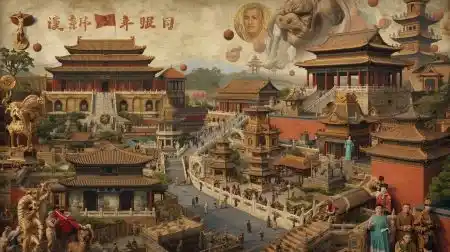
History of China is one of the longest, most continuous, and most remarkable historical narratives in the entire world, spanning over five thousand years of civilization, cultural evolution, dynastic rule, philosophical thought, technological innovation, and political transformation. China's history is often organized around its succession of imperial dynasties, beginning with the legendary Xia Dynasty and progressing through powerful empires such as the Shang, Zhou, Qin, Han, Tang, Song, Ming, and Qing dynasties, each contributing uniquely to the development of Chinese culture, governance, science, art, and territorial expansion. As one of the four great ancient civilizations of the world, China has made extraordinary and enduring contributions to human history that continue to influence the modern world in profound ways.The early dynasties of China established the political, philosophical, and cultural foundations upon which Chinese civilization was built. The Zhou Dynasty gave rise to the Hundred Schools of Thought, a golden age of intellectual activity that produced Confucianism, Taoism, and Legalism — philosophical traditions that shaped Chinese society, governance, and ethics for millennia. The Qin Dynasty, under Emperor Qin Shi Huang, unified China for the first time in 221 BCE, standardizing weights, measures, currency, and writing, and beginning the construction of the Great Wall of China. The Han Dynasty that followed is considered a golden age of Chinese civilization, during which the Silk Road was established, connecting China to Central Asia, the Middle East, and Europe through a vast network of trade and cultural exchange. Inventions such as paper, the compass, gunpowder, and printing — known as the Four Great Inventions — emerged during various dynasties and revolutionized human civilization worldwide.The medieval and early modern periods of Chinese history saw the rise of the Tang and Song dynasties, celebrated for their remarkable achievements in art, poetry, commerce, and technology. The Mongol conquests of the 13th century established the Yuan Dynasty under Kublai Khan, briefly uniting China within the vast Mongol Empire. The Ming Dynasty restored Chinese rule and oversaw magnificent achievements in architecture, including the construction of the Forbidden City in Beijing, and the famous voyages of Admiral Zheng He across Southeast Asia, South Asia, and East Africa. The Qing Dynasty, China's last imperial dynasty, ruled until 1912, when the Republic of China was established following the Xinhai Revolution. The 20th century brought immense upheaval — including the Japanese invasion, civil war between Nationalists and Communists, and the founding of the People's Republic of China under Mao Zedong in 1949. China's subsequent transformation through economic reforms under Deng Xiaoping into one of the world's leading economic and political powers represents one of the most extraordinary national transformations in modern history. Understanding the history of China is essential for comprehending the cultural values, political dynamics, and global ambitions of one of the world's most influential civilizations today.

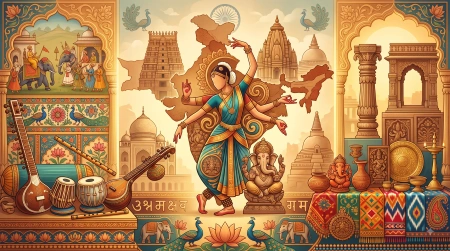
Indian History is a vast and rich tapestry of civilizations, empires, cultures, and movements that spans thousands of years, making India one of the oldest and most historically significant nations in the world. From the ancient Indus Valley Civilization — one of the world's earliest urban settlements — to the glorious Vedic Age, the Maurya and Gupta Empires, the medieval Sultanates, and the mighty Mughal Empire, India's history is a remarkable journey of cultural evolution, intellectual achievement, and political transformation. Each era has contributed uniquely to shaping the identity and heritage of the Indian subcontinent. The medieval period of Indian history witnessed the rise of powerful dynasties such as the Cholas, Rajputs, Vijayanagara Empire, and the Delhi Sultanate, each leaving behind extraordinary architectural, artistic, and administrative legacies. The arrival of the Mughals introduced a magnificent blend of Persian and Indian culture, evident in iconic monuments like the Taj Mahal and Red Fort. This period was also marked by religious movements, trade expansion, and the gradual arrival of European powers, particularly the British East India Company, which eventually led to British colonial rule over India. The modern period of Indian history is defined by the powerful struggle for independence against British colonialism, led by visionary leaders such as Mahatma Gandhi, Jawaharlal Nehru, Subhas Chandra Bose, and B.R. Ambedkar. The non-cooperation movement, civil disobedience, and the Quit India Movement collectively mobilized millions of Indians in the fight for freedom. India finally achieved independence on August 15, 1947, becoming a sovereign democratic republic. The post-independence era has been marked by nation-building, economic reforms, technological advancement, and India's emergence as a global power. Studying Indian history is essential for understanding the cultural, social, and political foundations of modern India.
Discover a wide range of quiz categories to test your knowledge and have fun!

Test your knowledge of recording, analyzing, and managing financial transactions.

Includes Physics, Chemistry, Biology, and General Science for school and competitive exams.

General Knowledge is a broad understanding of diverse subjects, facts, and current events that enhances awareness and learning.

Test your knowledge of farming, crops, and livestock with this fun and educational Agriculture Quiz.

Covers legal principles, rights, justice, and the system that governs society.