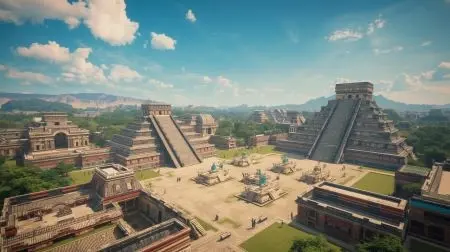
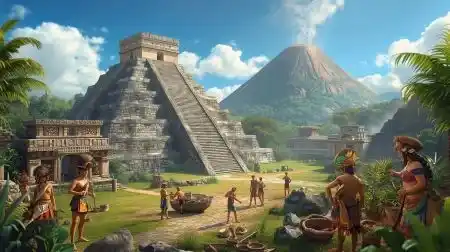
Mayan Civilization was one of the most sophisticated, intellectually advanced, and culturally rich civilizations of the ancient world, flourishing in the regions of present-day Mexico, Guatemala, Belize, Honduras, and El Salvador for over three thousand years. Spanning from approximately 2000 BCE to the arrival of Spanish conquistadors in the 16th century CE, the Maya developed a remarkable society characterized by extraordinary achievements in mathematics, astronomy, architecture, art, writing, and agriculture. Often considered the intellectual giants of the ancient Americas, the Maya created a complex and highly accurate calendar system, an intricate hieroglyphic writing system, and monumental stone cities that continue to astonish archaeologists and historians to this day. The Mayan civilization is typically divided into three major periods — the Preclassic, Classic, and Postclassic eras. The Classic period, spanning roughly from 250 CE to 900 CE, represented the peak of Mayan cultural and intellectual achievement, during which great city-states such as Tikal, Palenque, Copán, and Chichen Itza flourished as centers of political power, religious practice, and artistic production. Each city-state was ruled by a divine king, known as the "ajaw," who served as a mediator between the gods and the people. The Maya built towering pyramid temples, elaborate palaces, ball courts, and astronomical observatories aligned with celestial events, reflecting their deep understanding of astronomy and their spiritual connection to the cosmos. The intellectual achievements of the Maya remain remarkable by any historical standard. They developed one of the only fully functional writing systems in the pre-Columbian Americas, using a combination of logograms and syllabic signs to record history, mythology, astronomical observations, and religious rituals on stone monuments, pottery, and folded bark paper books known as codices. Their mathematical system independently developed the concept of zero — a profound intellectual achievement — and their astronomical calculations of solar, lunar, and planetary cycles were astonishingly precise. Mayan agriculture was equally sophisticated, employing terracing, raised field systems, and irrigation to support large urban populations in challenging tropical environments. Although the Classic Maya experienced a dramatic collapse around 900 CE due to a combination of warfare, drought, deforestation, and political instability, Mayan culture did not disappear entirely. Millions of Maya descendants continue to live in Mesoamerica today, preserving their ancestral languages, traditions, and cultural identity as a living testament to one of humanity's greatest civilizations.